So far, this has been a delightful holiday season. Last weekend, we drove to New Jersey to visit with Brian, Pam, and our grandson, Logan. We had a wonderful time! We were then able to celebrate Thanksgiving at our house with sons Jason and Jeff, along with Jeff's girlfriend Christine and her mom. The only ones missing from this holiday week reunion were our daughter Holly and her boyfriend Ryan, who are in San Francisco. But they are coming back home for Christmas, when the whole family will finally be together, if only for a short while.
Yesterday, my college roommate, Steve, and his wife, Sue, came to visit and stayed over until today. Some of you who follow my blog might recall some of his comments along the way, which he often signs OCRM (Old College Room Mate). Okay, Steve, you've just been outed! We had fun reminiscing about the old days at MIT. For some reason, most of his stories were usually at my expense. Why is that?
Then today, to top it off, we got together with our close friends, Bobby and Cathy, and their family to continue our tradition of going to a local tree farm and cutting down our Christmas trees. After that we celebrated in front of a roaring fire with hot chili and other treats. Not too shabby! I guess the Christmas season is now here. It's time for us to be jolly and don our gay apparel (fa la la), but I don't have any pink shirts!
Monday, Gretchen and I are going into the Farber for my monthly blood test and Zometa infusion. I am excited about being able to meet another MM patient there, Dee, who has an appointment with Dr. Richardson that day. We have communicated before, and I wrote about her story in a previous post: new-twist-on-lyme/mm-connection. She has also suffered from chronic Lyme Disease, and I am anxious to learn more from her about her experiences. I am slowly piecing together some of the stories I have gotten from a number of people about their experiences with Lyme or other autoimmune diseases and MM. Dee has one of the more interesting stories, connecting with a rare disease, NXG.
There was a story in yesterday's Boston Globe North Section about a local State senator, Brad Hill, who has recently been diagnosed with MM. As it turns out, Dr. Richardson is his oncologist, and he is quoted several times in the article. Here is a link to the article: state-rep-brad-hill-stays-job-while-undergoing-cancer-treatment. Paul Richardson is a big fan of metaphors. When I was first diagnosed with MM, Paul described a coordinated attack on MM by the Army, Navy, Air Force, and Coast Guard, which included MLN-9708, Revlimid, Dex, and Zometa. It was a very inspiring story as I sat in his office that first day, stunned with the realization that I had just been diagnosed with Multiple Myeloma. He has also used the metaphor of a mongoose and a python, where aggressive early treatment puts the MM python in a basket, and further maintenance therapy is the mongoose that keeps the python in the basket.
In this Globe article, Richardson adds some more colorful metaphors to his MM repertoir, and I quote: “The metaphor I use is that the stem cells are like salmon,” said
Richardson. “You catch them, and put them in
the freezer, and you give them back to the patient and reinfuse them,
just like a blood transfusion. The miracle of nature is these little
guys, just like salmon, swim back to where they’re born, and regrow in
the bone marrow. Whereas Brad previously had, kind of, crabgrass in his bone marrow
from the myeloma, after this chemotherapy all the crabgrass is wiped
out. Then the little salmon come back, they repopulate the bone marrow
. . . then you get Kentucky bluegrass.”
It's really comforting for me to know that I now have Kentucky bluegrass rather than crabgrass in my bone marrow. I've always liked Kentucky bluegrass.
Saturday, November 30, 2013


Monday, November 18, 2013
Farber Writing Workshop
I followed up my knee rehab appointment with another visit to my PT, Karen, last week. It is quite apparent that the range of motion is noticeably limited in my right knee. She left me with a full set of exercises that I can do at home and/or at the gym to help stretch and rebuild the muscles around my bum knee. It's a good excuse to get back to the gym regularly after my "summer" vacation, which has now extended through most of the fall.
My visits to rehab have been a bit humbling. First of all, Karen pointed out that I was bow legged, which puts more pressure on the inside of the knees, possibly accounting for my meniscus tear. Okay. Then she further volunteered that one leg is shorter than the other (I forget which one). It seems that I'm coming up a bit short (so to speak). I came out of there feeling like a deformed specimen of humanity. All I need is a hump on my back, and I could pass for Igor from "Young Frankenstein".
Speaking of deformities, one of the things I forgot to ask Karen about is my L1 vertebra
compression fracture, which may have been caused my my MM. Are there specific exercises that would either
help or hurt this condition? I have found that lying flat on my back using a
wooden yoga pillow under my lower back seems to help. Here is what it looks like:
 At first, it feels like a medieval torture instrument. It takes a
minute or two to relax into this posture while various vertebrae crack up and down my spine, but then it feels good. It takes me a while to clamber back onto my feet after this contortion exercise, but afterwards, my back feels great. I think this is a really helpful exercise, but I hope I'm not risking permanent disability or paralysis by my self-help therapy approach. If I make to January without incident, I plan to ask Karen's opinion on this.
I went into the Farber today for the monthly meeting of the Writing Workshop that I have been attending for the last two years. It was inspirational! The people there have endured the pain and uncertainty of being either cancer patients or caregivers, and they all bring talent and creativity to the room. They want to write for various reasons: to document their difficult journeys, to help them remember things they might otherwise forget, to find an outlet to express their feelings, or to leave a legacy for their loved ones, to name a few. It's amazing the clarity of purpose and zest for life that comes from knowing that one's time may be running out. I really enjoy interacting with these special people.
Amy, the coordinator, is great at challenging us and giving us guidance. At each workshop, she gives us a prompt, usually inspired by a poem, to write a piece addressing the prompt in only 10 minutes. That's a challenge! And then to read it out loud to the group? Gulp! Today, I couldn't believe the excellent pieces that rose to that challenge. I came away from that workshop filled with energy and inspired to write. I was determined to update my blog today. So I did.
My visits to rehab have been a bit humbling. First of all, Karen pointed out that I was bow legged, which puts more pressure on the inside of the knees, possibly accounting for my meniscus tear. Okay. Then she further volunteered that one leg is shorter than the other (I forget which one). It seems that I'm coming up a bit short (so to speak). I came out of there feeling like a deformed specimen of humanity. All I need is a hump on my back, and I could pass for Igor from "Young Frankenstein".

I went into the Farber today for the monthly meeting of the Writing Workshop that I have been attending for the last two years. It was inspirational! The people there have endured the pain and uncertainty of being either cancer patients or caregivers, and they all bring talent and creativity to the room. They want to write for various reasons: to document their difficult journeys, to help them remember things they might otherwise forget, to find an outlet to express their feelings, or to leave a legacy for their loved ones, to name a few. It's amazing the clarity of purpose and zest for life that comes from knowing that one's time may be running out. I really enjoy interacting with these special people.
Amy, the coordinator, is great at challenging us and giving us guidance. At each workshop, she gives us a prompt, usually inspired by a poem, to write a piece addressing the prompt in only 10 minutes. That's a challenge! And then to read it out loud to the group? Gulp! Today, I couldn't believe the excellent pieces that rose to that challenge. I came away from that workshop filled with energy and inspired to write. I was determined to update my blog today. So I did.
Friday, November 8, 2013
Rehab and Other Gab
I went to our mailbox today to post a letter that I wanted the mailman to pick up when he delivered today's mail. When I checked the box, however, the mail had already come. Drat! So I picked up today's mail and drove to the post office to mail my letter. When I got there, the letter had disappeared! What? I searched the car fruitlessly, so I drove back to the mailbox to see if I had dropped it along the way. When I got there, I found the letter neatly nestled in the mailbox. Duh! Chemobrain? Old age? Some combination of the two?
I read recently that doorways are memory erasers. I can purposefully walk from one room to another to accomplish something, but after going through the doorway, I stand there in bewilderment wondering why am I here in this room? I'm sure this doorway theory has some merit, because I have a lot of experience with it. I think the National Science Foundation should sponsor a study to verify this obvious conclusion. I mean really, it makes sense, doesn't it?
Monday was my monthly Farber day. Originally, I was scheduled to see Richardson, but the appointment was changed to see his nurse, Mary. I did have a couple of questions for Paul about the potential Lyme Disease connection, so I was a bit disappointed. On the other hand, I'm grateful that I'm doing so well that he doesn't need to see me on a regular basis. That puts things into the proper perspective.
My pathology results from last month's serum electrophoresis and immunofixation tests continue to show no M-spike and no gammopathy, which is great! So far, so good. Some of my other numbers have slipped a bit, however. My WBC dropped from 4.2 to 3.0, below the normal range, and my neutrophil count plummeted from 2.45 to 1.56, but still above the threshold of 1.0 where I would have to suspend taking the Revlimid. My hematocrit also fell to 33.9, the lowest level in more than a year. I just can't seem to shake this persistent anemia. Oh well, at least I feel good, except for needing more sleep than I used to.
I asked Mary how long I should keep taking monthly Zometa (bisphosphonate) infusions. She indicated at least two more years before moving to a 3-month schedule, because I need to build back my bones. I knew I had severe osteopenia at the the time of my MM diagnosis, but I didn't realize until Monday that I actually have a compression fracture of the L1 vertebra. That might explain why my lower back doesn't always feel so good. Do ya think?
I finally went to the physical therapist for my knee on Tuesday. I'm glad I went. Karen, the PT, gave me a number of exercises to keep limber and build up the muscles around my knee. I can do these exercises at home and at the gym. I have to admit that I have been slightly remiss about going the gym lately. By "slightly remiss", I mean I haven't been to the gym in about 4 months. OK, OK...20 lashes with a wet noodle, as Ann Landers used to say. Anyway, this should motivate me to get off my lazy ass and get back into the groove. Fortunately, the cortisone shot is still working, and I don't even notice my knee most of the time.
I want to thank the goodly number of my readers who responded to my posts about the possible connection between Lyme Disease or other autoimmune maladies and monoclonal gammopathies (MGUS/SMM/MM). There seem to be a lot of patients out there who have suffered the symptoms of chronic Lyme Disease some years before contracting MM or its precursors, some of whom have contracted other maladies along the way. Of course, these anecdotal cases don't show a definitive connection, but I smell enough smoke to think that there's a fire there somewhere. The real question is what is the mechanism for an overloaded immune system to trigger the mutations leading to myeloma? Perhaps understanding this could help lead to better treatments or at least increased vigilance leading to earlier diagnosis. I'm still soaking some of this in. I'll update this blog with my conclusions, assuming I come up with any.
Friday, November 1, 2013
Richardson's Talk Radio Interview
While I was away last week, I missed Dr. Richardson's blog talk radio panel discussion. Fortunately, I was able to access it when I got back and it did not disappoint. He clearly established why he is one of the preeminent MM specialists in the world! He addressed the question of when or if to do stem cell transplants in very direct and compelling terms. He also addressed a number of related issues, such as consolidation and/or maintenance therapy after transplant. For anyone who is interested in the entire episode, here is a link: http://www.blogtalkradio.com/curepanel/2013/10/24/dana-farbers-dr-paul-richardson-discusses-myeloma
One of the major contributing factors to my decision to have an early ASTC vs. waiting until first relapse was Paul's reference to Dr. Polumbo's research from Torino, Italy, showing some benefit for early transplant vs. waiting until first relapse. I blogged about that visit with Richardson on December 29, 2011: yesterday-was-very-good-day-at-dfci. Now, almost two years later, he still refers to that study as being relevant. That's good news, as there have not yet been any data to contradict that presumption, although clinical trials are still underway to answer that question. In my mind, the answers may never be definitive, and either choice may be fine. In any case, I'm happy I made the decision I did, and I certainly can't complain as I am still in remission a year and a half later.
On the issue of consolidation and maintenance therapy, Dr. Richardson strongly recommended at least following a maintenance regimen after a transplant or even after successful initial drug therapy. While all studies show a Progression Free Survival (PFS) benefit of maintenance (usually Revlimid), some studies don't show any Overall Survival (OS) benefit, which of course is the bottom line. Paul suggested that the reason is that many studies only continued maintenance for 2 years and then discontinued it. He reasons that this is a mistake. A Polumbo study showed OS benefits for maintenance until first relapse. Paul's take is that 2 years isn't long enough. Revlimid has a slight risk of inducing a secondary cancer, but that risk is almost always in the first 2 years. Why take the risk of the secondary cancer without continuing the therapy after the risk is no longer a factor?
Here's the thing. Unlike most cancers, MM is a cytogenetically active disease, where individual patients undergo mutations of the monoclonal proteins over time. I have blogged about this in the past. High-risk patients, such as myself, are even more prone to mutations that will create another monoclonal spike, which accounts for our more pessimistic prognoses. Continuous treatment with an IMID (Immunomodulatory Drug) , such as Revlimid, helps keep these mutated clones under control. Especially after a stem cell transplant, Revlimid helps the new immune system keep an active eye on these mutations as they occur and keep them at bay. This makes a lot of sense to me.
Some have argued that by continuing to give maintenance therapy over a long period of time, one can become resistant (refractory) and it won't work anymore. That used to be a big problem when there were few options to replace the resistant drug. But fortunately that's not the case these days. For example, the IMID Pomalyst has now been approved by the FDA for relapsed MM, which can substitute for Revlimid. Yay! Now I don't have to worry that if Rev someday stops working, I have no other options.
I am currently on a clinical trial, which involves continuing my Rev maintenance therapy for 3 years. If I am fortunate enough to still be in remission at the end of that trial, I will have a decision to make about whether to stop treatment all together or continue on some maintenance therapy. That decision is a long way off, and I hope that all the ongoing research will give me good insight as to what path I should take going forward. Right now, I just hope that is a decision I get to make.
I have other issues to blog about, including more on the Lyme Disease connection and other potential MM links, but I'll put that off until another day. I have an appointment with Dr. Richardson on Monday. I may have something to report about on that.
Wednesday, October 23, 2013
New Twist on Lyme/MM Connection
I have received a couple of interesting emails lately regarding the connection between MM and autoimmune diseases, including Lyme Disease. One writer, Kate, has IGA Lambda MM with the t(4;14) translocation, as I have. While she says she does not have Lyme, she suffers from a variety of symptoms that her doctors say are autoimmune related. (I wonder if she might actually have a case of undiagnosed Lyme. Since the tests are so unreliable, there may be no way to know for sure.) Her oncologist acknowledges an association between autoimmune disorders and MM, but the MM experts don't know what the relationship is yet. She has also read that IGA MM patients have higher rates of both autoimmune diseases and t(4;14) translocations than other types. Interesting. This just adds more fuel to the fire about this type of connection, as far as I'm concerned.
Today I received a fascinating comment on one of my earlier posts about Lyme Disease. Dee has been treated for Lyme Disease several times, but she feels she had undiagnosed Lyme before that. She continues to have the usual range of symptoms indicating chronic Lyme. Fortunately, she is seeing a Lyme-literate doctor.
This year, she was diagnosed with an extremely rare disease: necrobiotic xanthogranuloma (NXG). Only about 125 cases a year are reported for this disease, and most of the literature is from Europe, primarily by those in the Lyme Disease community. However, NXG has been found to have a very high correlation with MM. She went to an oncologist and found she had elevated monoclonal protein. After a bone marrow biopsy (BMB), she was found to have Smoldering Myeloma (SM), and they also found Lyme bacteria Borrelia burgdorferi (Bb) spirochetes in her bone marrow! Wow!
This seems to establish a potential triad between Lyme Disease, NXG, and Multiple Myeloma. In fact, I found a paper establishing this 3-way link: http://www.medscape.com/viewarticle/721924_5. In a retrospective study, 80% of NXG patients showed monoclonal gammopathies. Furthermore, the paper states, "NXG biopsies suggested the presence of Borrelia spirochetes in six of seven samples, implicating spirochetes as a potential trigger for NXG".
Right now, my head hurts trying to assimilate all this information. While NXG is very rare, this reveals one probable pathway between Lyme Disease and myeloma, showing that the Lyme Bb instigates the NXG, which in turn instigates the monoclonal gammopathy. This implies cause and effect, not merely correlation. Bb is an extremely complicated and resourceful bacterium. It has many deleterious effects on the human body (as I myself have discovered), but I remain convinced that one of the more pernicious effects is that Lyme Disease is a potential trigger for monoclonal gammopathies, including MGUS, SM, and MM. I'm sure I will be blogging about this more as I gather more information on this topic.
Tomorrow I am headed up to the family farm in Champlain, NY for a relaxing weekend with my son, Jeff, and good friend, Bobby. Since we don't have good wireless connections there, I may miss a good blog talk radio show tomorrow night at 6:00 featuring Dr. Paul Richardson. Here is the link: http://www.blogtalkradio.com/dr-paul-richardson-discusses-myeloma. The topic is To Transplant or Not To Transplant: Thats the Question. Fellow blogger Pat Killingsworth is one of the panelists. I already know Paul's view on this, as we have discussed it at length. However, it is a hot topic of conversation these days in the MM community. Several clinical trials are underway to help answer this question (including the one I am on), so it will be interesting to see if there are any new developments on this topic. If I miss it, I hope someone will fill me in on it, or I can view it later.
Wednesday, October 16, 2013
DVT Risk
One of the side effects of my Revlimid treatment is the risk of a deep vein thrombosis (DVT), which is a blood clot which usually forms in the legs. Such a clot could break loose and travel to the lungs, causing a pulmonary embolism. That would not be a good thing. My friend, Bobby, had one of these a few years ago, and it was pretty serious. Fortunately, he is now fine. I have been taking a full dose of aspirin every day since being on Rev to minimize the chance of a DVT. Every month during my physical exam at the Farber, they check to see if there is any pain or tenderness in my lower legs, which might indicate a potential DVT.
Today in the shower, I noticed that my right lower leg was very sensitive to the touch about 8 inches above the ankle. Hmmm. I didn't notice any swelling, warmth, or redness, so I wasn't too concerned. However, I plan to monitor this very closely.
I went online to see what was published about this, and I found this recent article in the Myeloma Beacon addressing this issue: blood-clots-multiple-myeloma-thalidomide-revlimid/. The bottom line is that aspirin has been found not to be that effective in preventing blood clots for these patients. About 7% of patients who take aspirin on long-term Revlimid therapy still develop blood clots, about the same percentage as those who don't take any blood thinners. However, those taking heparin or Coumadin fared much better. Hmmm. If this gets any worse, I will definitely call Mary at the Farber for advice. Stay tuned.
Today I had a followup visit for my knee. Fortunately, the cortisone shot for the osteoarthritis (OA) is still working, so it feels pretty good. I played 9 holes of golf yesterday walking with my pull cart and had no issues with the knee at all. I told Frank, the physician's assistant, that I felt about 85% back to normal (not 85% better, as I rambled on about in a previous blog post). He was pleased, and said most people get about 4-6 months improvement from the cortisone. The next question is what to do when it wears off. Another cortisone shot is the most obvious next step, especially if this one lasts a long time. At some point though, that may not work any more.
 One alternative would be knee replacement surgery (gulp!). I have no intention of going in that direction. Just look at the surgery scars in the picture. Fuggetaboutit! I don't plan on entering any iron-man triathlons, so just getting around without much pain will work just fine for me.
The next step would be injections of hyaluronic acid, which can provide up to 6 months or more of pain relief for OA. This is sometimes referred to as "motor oil" for the knee, as it replaces the lost joint fluid causing the pain from OA. This typically requires 3 weekly injections to lubricate the knee joint. My doctor uses a brand called Orthovisc. Our good friend, Marilyn, has a similar knee problem to mine, and she has had two injections of a similar brand, Synvisc, over the past four years with great results. As of now, however, my knee feels OK, so I'll just keep that option in my back pocket.
I have been remiss in setting up a physical therapy (PT) appointment to help rehabilitate my knee, so today I made an appointment for early November. I hope to go to a couple of sessions to find out what exercises will help the most, and then perhaps continue them at home or at the gym. We'll see.
Today in the shower, I noticed that my right lower leg was very sensitive to the touch about 8 inches above the ankle. Hmmm. I didn't notice any swelling, warmth, or redness, so I wasn't too concerned. However, I plan to monitor this very closely.
I went online to see what was published about this, and I found this recent article in the Myeloma Beacon addressing this issue: blood-clots-multiple-myeloma-thalidomide-revlimid/. The bottom line is that aspirin has been found not to be that effective in preventing blood clots for these patients. About 7% of patients who take aspirin on long-term Revlimid therapy still develop blood clots, about the same percentage as those who don't take any blood thinners. However, those taking heparin or Coumadin fared much better. Hmmm. If this gets any worse, I will definitely call Mary at the Farber for advice. Stay tuned.
Today I had a followup visit for my knee. Fortunately, the cortisone shot for the osteoarthritis (OA) is still working, so it feels pretty good. I played 9 holes of golf yesterday walking with my pull cart and had no issues with the knee at all. I told Frank, the physician's assistant, that I felt about 85% back to normal (not 85% better, as I rambled on about in a previous blog post). He was pleased, and said most people get about 4-6 months improvement from the cortisone. The next question is what to do when it wears off. Another cortisone shot is the most obvious next step, especially if this one lasts a long time. At some point though, that may not work any more.
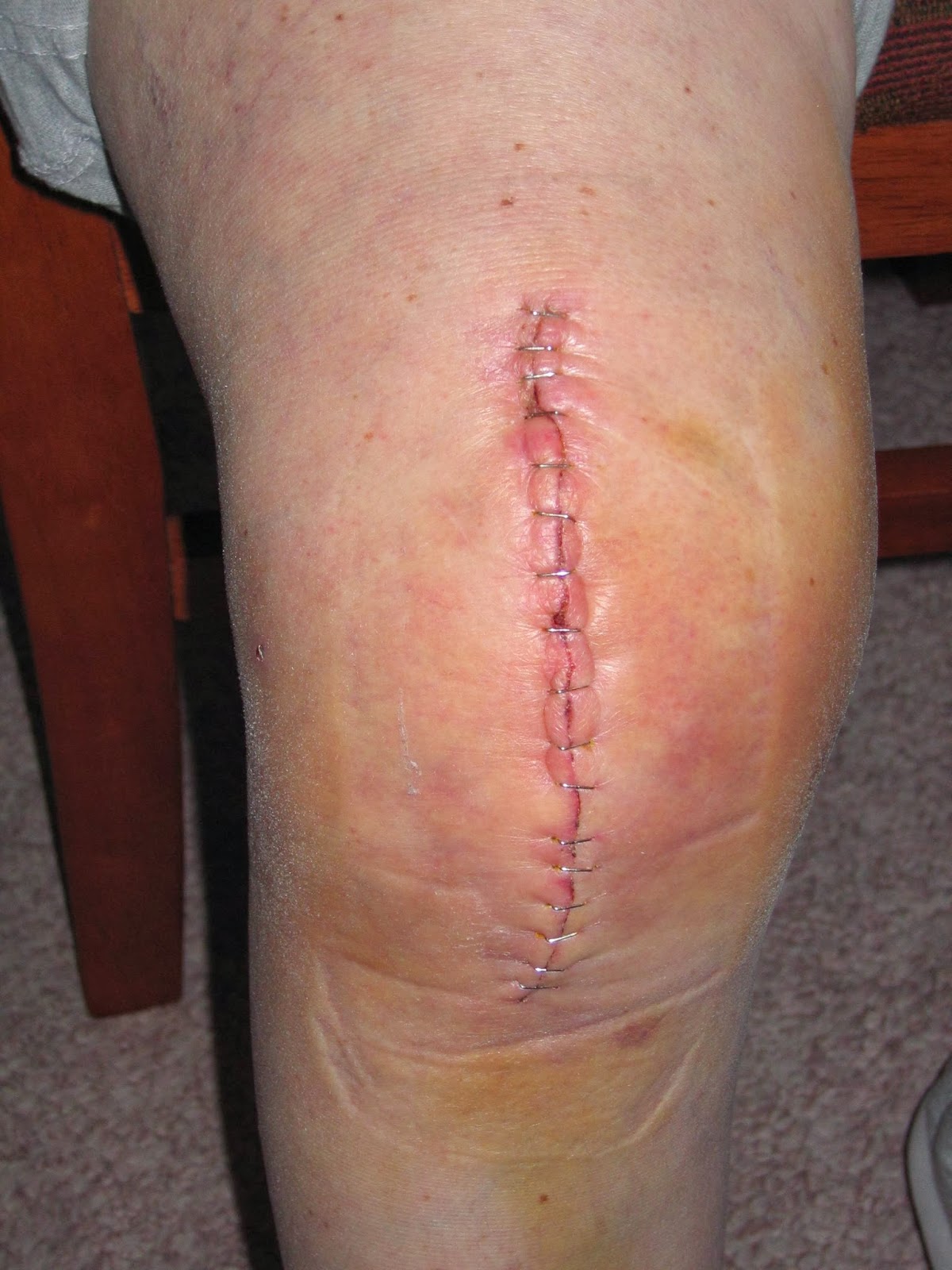 One alternative would be knee replacement surgery (gulp!). I have no intention of going in that direction. Just look at the surgery scars in the picture. Fuggetaboutit! I don't plan on entering any iron-man triathlons, so just getting around without much pain will work just fine for me.
The next step would be injections of hyaluronic acid, which can provide up to 6 months or more of pain relief for OA. This is sometimes referred to as "motor oil" for the knee, as it replaces the lost joint fluid causing the pain from OA. This typically requires 3 weekly injections to lubricate the knee joint. My doctor uses a brand called Orthovisc. Our good friend, Marilyn, has a similar knee problem to mine, and she has had two injections of a similar brand, Synvisc, over the past four years with great results. As of now, however, my knee feels OK, so I'll just keep that option in my back pocket.
I have been remiss in setting up a physical therapy (PT) appointment to help rehabilitate my knee, so today I made an appointment for early November. I hope to go to a couple of sessions to find out what exercises will help the most, and then perhaps continue them at home or at the gym. We'll see.
Monday, October 7, 2013
Farber, Knee, and LLS
After several weeks of relative quietude on the blogging front, I have more topics to cover today. This morning I had my monthly Farber appointment. I hadn't bothered to look at the schedule in detail--I just knew I had to be there at 10:15. When I got there and finally checked the appointments, I found there was good news and bad news. The good news was that I was scheduled to meet with Dr. Richardson! The bad news was that I was scheduled to meet with Dr. Richardson! The good part was that I haven't seen him since May, and I was delighted to have the opportunity to talk to him again directly about my situation. The bad part was that I knew it was going to be a long day.
While I was waiting, I met with Muriel. My numbers this month were great! The pathology results from last month confirmed no monoclonal gammopathy again, meaning I'm still in remission. The bilirubin, which I was concerned about last month, dropped from 1.7 to 1.0, back in the normal range. Muriel said that a number of patients on Rev maintenance have had similar random jumps in bilirubin with no apparent cause. While a high bilirubin can be indicative of liver problems, none of my other liver indicators are out of line, so it may just be a spurious side effect of the Revlimid. (Phew! I'll drink to that.) My neutrophil count continues to be great at 2.45, well into the normal range, despite the fact that I am taking Rev every day. Almost everything else was in the normal range. The only negatives were my HCT and Hgb counts, which have both dropped somewhat, which means my anemia is not getting any better. That may explain why I still need 9-10 hours of sleep every night, and I still often nap during the day. You know what? It's a small price to pay for how good I've been feeling.
By the way, my knee still feels great! I totally forgot to bring in the CDs with my Xrays and MRIs. Damn! Anyway, Muriel said that it was no big deal, because it won't affect any of my treatments at the Farber. They just want them for complete records, so hopefully, I'll remember to bring them next time. (Siri, remind me!) However, she did strongly suggest that I take advantage of the PT prescription I got from the ortho doc. It can only help, and after the cortisone wears off, it would be good to have built up some of the surrounding muscle. I can't say I disagree, so maybe I'll try it out for a session or two, and maybe I can continue to do the appropriate exercises at the gym on my own.
I'm glad I brought my computer and Kindle, so I was able to surf the Net and read while waiting for Dr. Richardson. He finally arrived at 1:50, two hours and 50 minutes behind schedule. I was thinking that might have set a new record for promptness, but not so. I checked my records, but in May he was only two hours and 40 minutes behind. It was definitely worth the wait though, as it always is.
After his examination, Dr. Richardson's overall assessment is that I am doing great! He also thinks that I am looking really good. It's nice to hear these words from him, because in the past he has been very blunt when he thinks otherwise. I left the meeting with him feeling super! Have I ever mentioned that I am really grateful that he is my doctor?
While waiting for Richardson, I perused the DFCI internal publication, "Inside the Institute", which had an interesting article about a $6 million grant from the Leukemia and Lymphoma Society (LLS) to Dr. Irene Ghobrial, one of Richardson's colleagues, to study the biology of clonal evolution of MM to help develop drugs to prevent the progress of the malignancies. The objective is to help find ways to prevent the progression of precursor conditions (such as MGUS and Smoldering Myeloma) to full blown MM, by finding why MM cells attack the bone marrow and what factors instigate the clonal mutations causing the malignancies. If such an approach could successfully stymie progression from precursor MM to active MM, perhaps the same approach could also help prevent those in remission from relapsing. I don't know, but it occurs to me that it would be a reasonable possibility. I'm excited by this research direction, and from all I have read so far about this, I feel that in addition to the powerful new drugs becoming available, treating clonal mutation abnormalities at the molecular level will eventually lead to individualized treatment regimens and potentially a cure for MM.
I brought this subject up with Dr. Richardson, and he acknowledged that the entire Farber team is involved in this research, and it is a very promising endeavor. Let's just hope!
Tuesday, October 1, 2013
Overdue Update
One of my loyal readers emailed me yesterday saying she misses seeing frequent updates to my blog, which was a nice way of telling me to get off my lazy ass and start writing. Guilty as charged! I don't why I took this little vacation. It's not that I'm so busy that I can't fit writing this blog into my crammed schedule of meetings and social events. As a matter of fact, as I look over my calendar, it is nearly blank, sad to say. No, just a little laziness and procrastination. Over the years, I have elevated the process of procrastinating to a fine art, sometimes to my chagrin. In any case, I'm back.
When we last left the saga of my thrilling adventures, I had just left the orthopedic doctor's office with a shot of cortisone in my right knee. Wow! That's pretty good stuff. My knee immediately felt better, and it still does. I can now walk and negotiate stairs with minimal pain. I even walked a 9-hole golf course a few days ago with no discernible aftereffects. It's still not perfect, but it's "100% better", as they say.
Now that I think of it, I'm not sure what 100% better is supposed to mean. Better than what? For example, if I started out only 5% good and got 100% better, I would still only be 10% good, right? Conversely, if I started out 90% good, I'd only have to get better by 11.1% to be perfect again. Maybe I just have an odd way of looking at things. Anyway, I digress.
By the way, a cortisone shot in the knee is no walk in the park. However, on a relative scale, it sure beats the shit out a bone marrow biopsy. I'm not sure how long this cortisone shot will last. The physicians assistant said it could last anywhere from 3 weeks to 3 years. Typically, I guess 6 months would be a reasonable expectation. After that, I don't know what might come next. In the mean time, I'll try not to do anything too strenuous with it.
I'm feeling really good, although I still sleep more than I used to. I've pretty much adjusted to that. Yesterday I got my flu shot and next Monday, I go back to the Farber for another monthly checkup and Zometa infusion. That will begin the 15th month of my clinical trial maintenance therapy with the 5 mg of Revlimid daily. If I can stay in remission for another 22 months, then I can go off the Rev completely, and maybe the Zometa as well. I'm looking forward to that. I'm very upbeat about how everything has gone so far. In fact, as a testament to my optimism, I just took the plunge and renewed my AARP membership for another 5 years!
The writing seminar at the Farber has started up again for the fall. Unfortunately, I missed the September workshop because of my knee appointment. I hope to be able to attend the October one on the 28th. I could use a shot in the arm to bolster my inspiration to keep writing..
Monday, September 16, 2013
Knee Problems
In my last post, I mentioned the sudden onset of a problem with my
right knee for no reason at all. So I had X-rays and an MRI done, and last week I got the
results. The good news was that all the ligaments are intact. The bad
news was that almost everything else sucks.
The findings were that I have maceration and tears in the medial (inner) miniscus that go from back to front, a possible tear in the lateral (outer) miniscus, joint effusion (aka water on the knee), Baker's cyst and a loose cartilage body behind the knee, and severe osteoarthritis in all 3 joints, with the most serious being chondromalacia (similar to runner's knee). This latter condition is apparent in the attached X-ray picture, which shows that I have almost no cartilage between my knee cap and femur. Normally, there should be about a centimeter of spacing there. Now the bones are practically rubbing together. Creak!
Looking at these findings, I was wondering how I could walk at all! Shouldn't I be in a wheel chair? Surprisingly, however, I've been pretty mobile. I have some pain, mostly going up and down stairs, but especially after walking for a round of golf (I refuse to rent a cart!). However, the pain has been tolerable, and I haven't bothered to take any pain relievers for it.
I was kind of disappointed that this happened, because I had been harboring secret thoughts about trying to get in shape to run in a 5K event some time next year in a cancer fund raiser for Multiple Myeloma or Dana Farber. I had started combining walking with jogging on the treadmill at the gym early in the summer, but I kind of dropped out of the gym over the last couple of months. I was planning to try to get back in shape again once fall rolled around, but ironically, this happened out of the blue, without my putting any stress at all on the knee. Go figure.
Today I met with my osteopathic surgeon, Dr. Mattheos. He was great at treating me after I fell off the ladder last year, although it hurt like hell when he yanked my dislocated finger back into place. Grrrr! But I have forgiven him for that. He seemed a little surprised that I wasn't in more pain than I was. My knee actually feels pretty good, with most of the pain on the inner side where the main meniscus tear is. He explained that he could do arthroscopic surgery to repair the tear, but that could actually make things worse, which was his way of telling me that my knee is pretty fucked up. The main problem is my arthritis, and cartilage repair surgery might actually exacerbate that.
The upshot is that he recommended a cortisone shot to reduce the swelling and let the cartilage try to heal naturally. So that's what I got. Who knows if that will work, but it feels pretty good right now. I also got a prescription for some PT, which I may or may not use. I have a follow-up visit in 4 weeks to see how it's progressing. He thinks it is possible that I could get back to normal activity. Who knows? There might be a 5K run in my future yet. But I don't think I will try running anytime soon.
 |
| Knee X-ray showing severe arthritis |
The findings were that I have maceration and tears in the medial (inner) miniscus that go from back to front, a possible tear in the lateral (outer) miniscus, joint effusion (aka water on the knee), Baker's cyst and a loose cartilage body behind the knee, and severe osteoarthritis in all 3 joints, with the most serious being chondromalacia (similar to runner's knee). This latter condition is apparent in the attached X-ray picture, which shows that I have almost no cartilage between my knee cap and femur. Normally, there should be about a centimeter of spacing there. Now the bones are practically rubbing together. Creak!
Looking at these findings, I was wondering how I could walk at all! Shouldn't I be in a wheel chair? Surprisingly, however, I've been pretty mobile. I have some pain, mostly going up and down stairs, but especially after walking for a round of golf (I refuse to rent a cart!). However, the pain has been tolerable, and I haven't bothered to take any pain relievers for it.
I was kind of disappointed that this happened, because I had been harboring secret thoughts about trying to get in shape to run in a 5K event some time next year in a cancer fund raiser for Multiple Myeloma or Dana Farber. I had started combining walking with jogging on the treadmill at the gym early in the summer, but I kind of dropped out of the gym over the last couple of months. I was planning to try to get back in shape again once fall rolled around, but ironically, this happened out of the blue, without my putting any stress at all on the knee. Go figure.
Today I met with my osteopathic surgeon, Dr. Mattheos. He was great at treating me after I fell off the ladder last year, although it hurt like hell when he yanked my dislocated finger back into place. Grrrr! But I have forgiven him for that. He seemed a little surprised that I wasn't in more pain than I was. My knee actually feels pretty good, with most of the pain on the inner side where the main meniscus tear is. He explained that he could do arthroscopic surgery to repair the tear, but that could actually make things worse, which was his way of telling me that my knee is pretty fucked up. The main problem is my arthritis, and cartilage repair surgery might actually exacerbate that.
The upshot is that he recommended a cortisone shot to reduce the swelling and let the cartilage try to heal naturally. So that's what I got. Who knows if that will work, but it feels pretty good right now. I also got a prescription for some PT, which I may or may not use. I have a follow-up visit in 4 weeks to see how it's progressing. He thinks it is possible that I could get back to normal activity. Who knows? There might be a 5K run in my future yet. But I don't think I will try running anytime soon.
Friday, September 6, 2013
One of Those Days
Today is one of those days.
Last week I suddenly had a pain in my right knee while just walking around the house, so I went to the doctor. He sent me to have an x-ray and MRI, which I went to the local hospital for on Tuesday. In the meantime, I have been hobbling around with a knee bandage for the last week. I played 9 holes of golf yesterday walking (I'm too proud and cheap to take a cart), so the knee didn't feel so good today. This morning, my doctor's office called to report that I have a cartilage tear in my miniscus. Great! So I have scheduled an appointment with an orthopedic surgeon to see what happens next. That started my day.
My meds had run out, so I checked with Express Scripts this morning and was told I couldn't get them until October. So I called my doctor's office and had an emergency supply sent to the local pharmacy to last me for a while. When I went to pick them up, I had a flat tire in the parking lot. While trying to change the tire, the lock nut was on so tight that I broke it trying to get it off. So I called AAA (not AA), who came about 45 minutes later, and he couldn't get it off either. So he put enough air in the tire for me to get to the local Midas, where they had to force it off with an air hammer. By then, I realized that I needed new tires, so they put on the spare and I drove to New Hampshire to buy new tires. But in my brute strength (yeah right!) to try to force off the lock nut, I had also broken the key to the lock nut, so they had to also forcibly remove and destroy all the other lock nuts before installing my new tires. No more lock nuts. If anyone wants to steal my tires, just come and get them! After about two hours and a thousand dollars later, I was finally back on the road. That was fun.
When I finally got home about 6:30 after my odyssey adventure to pick up my emergency prescription, Gretchen informed me that they had actually been delivered by Express Scripts last week, but she had put them aside thinking that they were hers. Oops. Some days are like this. Today is one of those days. You just have to laugh about it.
I have been very lazy about updating this blog. I should have updated this days ago, but I wasn't feeling very creative. I went to the Farber on Monday for my monthly checkup, and things are still good. I didn't want to put up a blog post just saying that everything was still fine. Yawn.
Anyway, positive changes include my white blood cell count up significantly to 4.7, and my RBC, HCT, and Hgb have all increased, indicating that my anemia is alleviating somewhat. The only negative number is my bilirubin, which jumped to 1.7 (normal is less than 1.2). This can be indicative of potential liver problems. Hmmm. I wonder if that might have anything to do with the prodigious amount of wine that I consumed during our baccanalian Labor Day weekend bash. I'm not sure I remember all of it, but we had a great time! Oh yes, and don't tell Dr. R.
Subscribe to:
Posts (Atom)